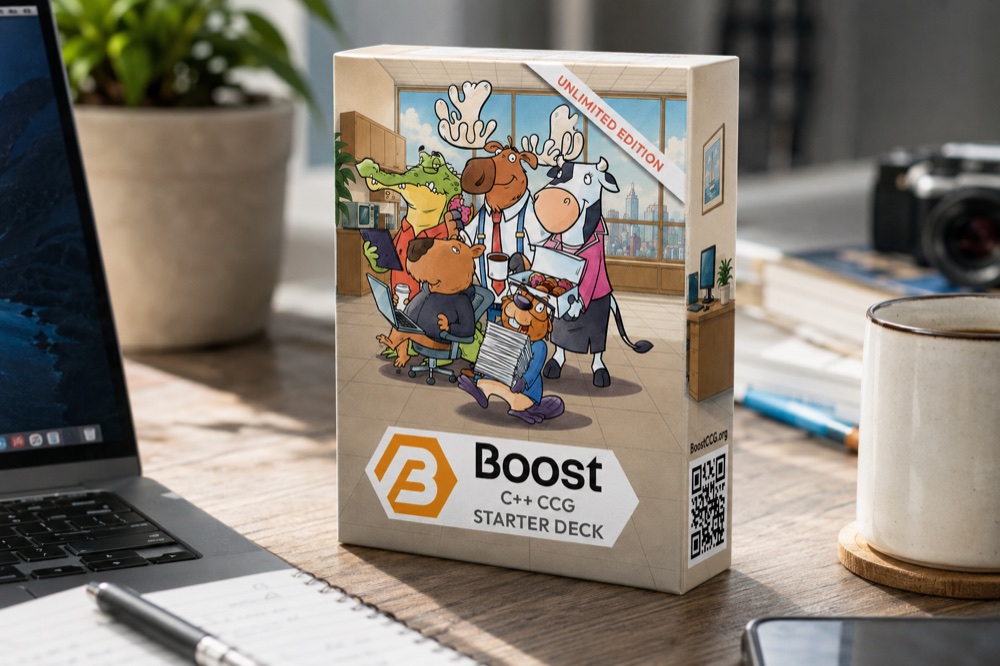
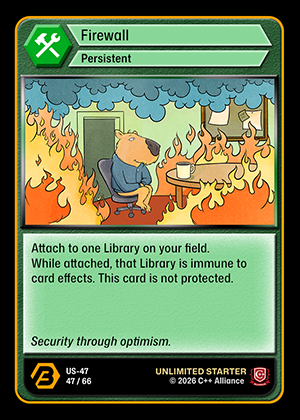
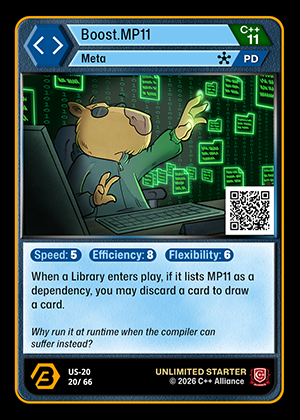
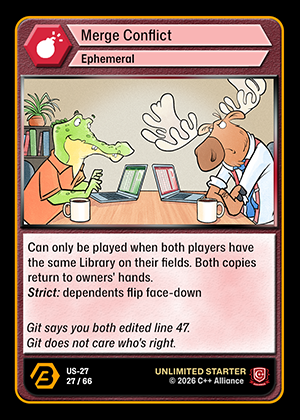
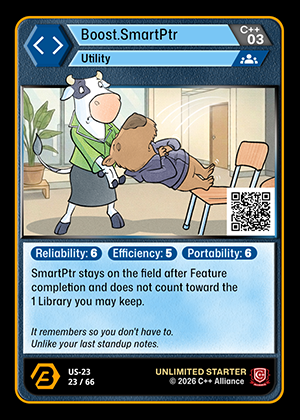
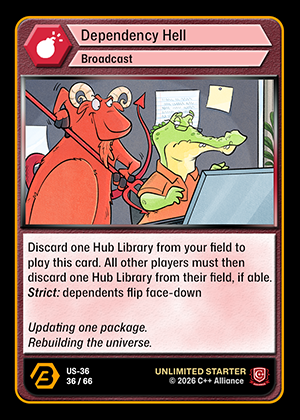
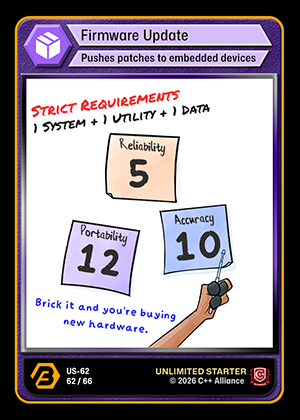
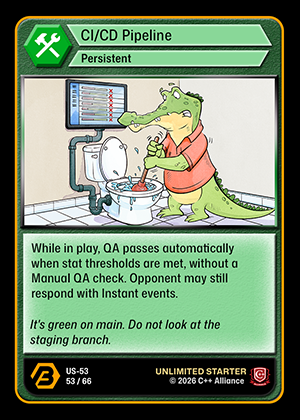
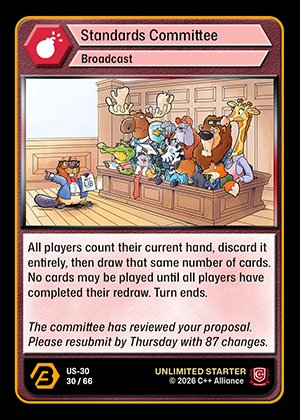
The Boost CCG crew, crocodile, moose, cow, capybara and beaver, hanging out in their office
#include <boost/ccg.hpp>

Compile.
Ship.
Sabotage.

Every card is a real Boost library, tool, or real-world circumstance. Real stats, real tradeoffs. Manage your stack, pass code review, and ship before the other dev merges.

STARTER DECKS AVAILABLE NOW!
New here?

Play in Your Browser

Jump into a full game against the compiler, start to finish.

›
New On your phone

Build Tracker

Playing with the real cards? Keep score of your Features, stats and QA on a phone at the table.

›
New Never coded?

What the Cards Really Are

Every card is a real piece of software. Learn what they do and you've learned how programs get built.

›
The full spec

Read the Rules

The complete Developer's Edition rulebook, v3.

›

Deep Strategy

A continually growing library of cards. Infinite interactions. Endless ways to win.

Built Different

Real dependencies, instant-speed plays, and clever rules set BOOST apart.

Growing Community

Join engineers around the world sharing decks, strategies, and off-by-one jokes.

Compete & Win

Challenge a coworker at the conference table and settle who really ships faster.

The Boost CCG Unlimited Starter Deck box on a desk
The physical game

Real cards, on a real table

Boost CCG is a printed collectible card game you can hold, shuffle and play with a friend. The starter deck is a complete, ready-to-play game: 66 cards, each one a real Boost C++ library, tool, author, or the kind of chaos that turns up on the way to shipping.

2+ players 10-30 min Ages 8+ 66 cards Ships worldwide
Play free first

Latest News

View all news →
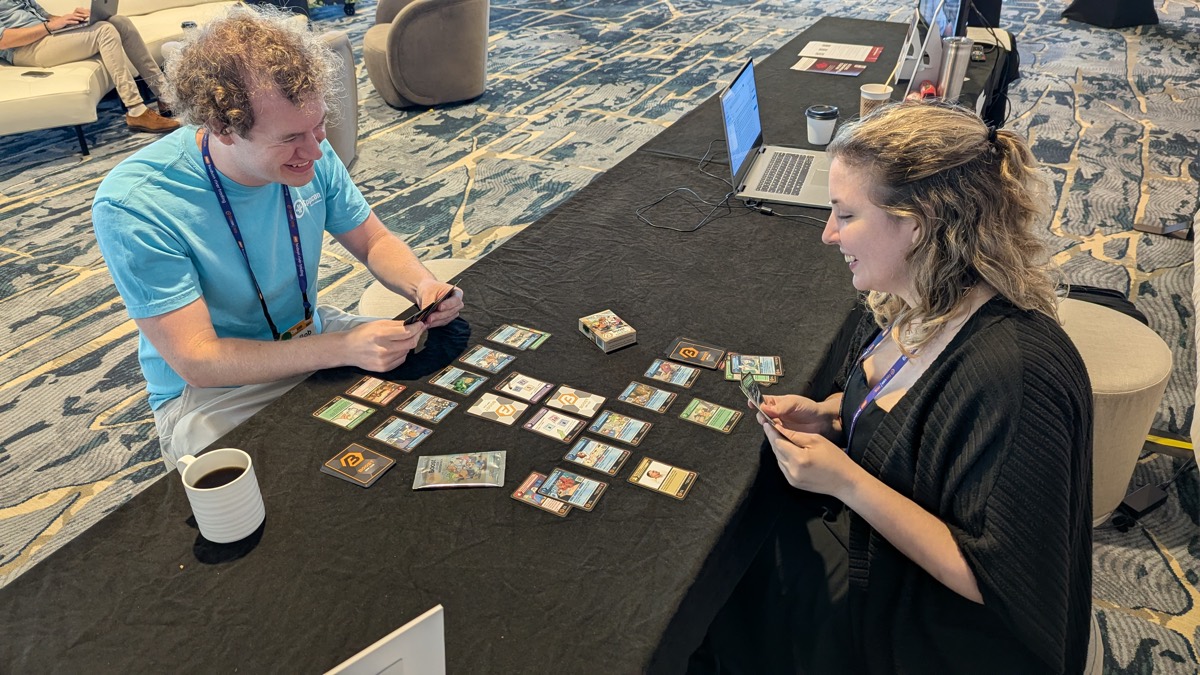
Two attendees playing Boost CCG at the Boost Lounge table during CppCon 2026. Recap
Sep 20, 2026

CppCon 2026 Roundup: Thanks for Stopping By!

Thank you to everyone who visited the Boost Lounge at CppCon. A professional video is on the way, special Author cards were handed out in person, and we're already planning next year. Tell us what you want to see.

Read more →
Link the moose and the AI booster cards Card Preview
Jul 13, 2026

A First Look at the Boost CCG Booster Set

The AI-card stack, new Author cards you can get signed on-site, and new libraries, hazards, and Features.

Read more →
Boost mascots at the CppCon banner Announcement
Jul 20, 2026

The Boost Card Game Arrives at CppCon 2026

Every registered attendee goes home with a free starter deck: the complete, rebalanced game, not last year's preview.

Read more →

Featured Cards

View full card list →

Meet the Crew

More about the game →
Patch the beaver
Patch
Beaver · Junior dev
The protagonist. Relentlessly optimistic: believes every bug is fixable and every feature shippable if you just keep building. Eager, earnest, and occasionally in over his head.
Stack the capybara
Stack
Capybara · Senior dev
Unflappable. Nothing (not a prod outage, not a rewrite, not a Friday deploy) gets a rise out of him. Calm, dry, and quietly competent.
Proc the crocodile
Proc
Crocodile · Senior dev
Pragmatic and blunt. Cuts the scope, kills the bikeshedding, ships it. Low patience for ceremony, high respect for working code.
Link the moose
Link
Moose · Manager
The sociable connector. Knows everyone, schedules everything, and smooths the friction between people. A people-person who'd rather talk it out than read the spec.
Trace the cow
Trace
Cow · Product manager
The one who actually knows where everything stands. Tracks tickets, timelines, and loose ends; keeps the team honest about what's really done versus "done."
← Back to home

All News

Two attendees playing Boost CCG at the Boost Lounge table during CppCon 2026. Recap
Sep 20, 2026

CppCon 2026 Roundup: Thanks for Stopping By!

Thank you to everyone who visited the Boost Lounge at CppCon. A professional video is on the way, special Author cards were handed out in person, and we're already planning next year. Tell us what you want to see.

Read more →
Boost CCG Unlimited Starter Deck box and cards Pre-orders
Jul 20, 2026

Preorders Are Now Open

The starter deck is now available to order, no conference badge required. Booster packs are available too.

Read more →
Boost mascots at the CppCon banner Announcement
Jul 20, 2026

The Boost Card Game Arrives at CppCon 2026

Every registered attendee goes home with a free starter deck: the complete, rebalanced game, not last year's preview.

Read more →
Link the moose and the AI booster cards Card Preview
Jul 13, 2026

A First Look at the Boost CCG Booster Set

The AI-card stack, new Author cards you can get signed on-site, and new libraries, hazards, and Features.

Read more →
← All news /news/ · Recap

CppCon 2026 Roundup: Thanks for Stopping By!

Sep 20, 2026 Two attendees playing Boost CCG at the Boost Lounge table during CppCon 2026.

What a week. Thank you to everyone who swung by the Boost Lounge at CppCon this year. We had a blast teaching people the game, walking through the rules, and watching first matches play out over the table. Seeing the community pick it up and start scheming their decks made all the work worth it.

A few highlights and things to look forward to:

A proper video is on the way. We filmed a professional video all about the game: what it is, how it plays, and the ideas behind it. We'll be posting it right here on the site before long, so keep an eye out.

Some cards you couldn't get anywhere else. Matt Borland, René Rivera, and Alan de Freitas were handing out special Author cards you could only get from them in person. If you missed your chance this time, don't lose hope. You never know when you might run into them at a future event, and it never hurts to ask!

Already looking ahead to next year. We're excited about what's coming, including new boosters and maybe a few other related goodies too. And this is where you come in. If there's something you'd love to see, tell us! Drop your ideas in the Discord and help shape where the game goes next.

Thanks again to everyone who made this year special. See you at the table.

Join the Discord
← All news /news/ · Pre-orders

Preorders Are Now Open

Jul 20, 2026 Boost CCG Unlimited Starter Deck box and cards

Not everyone can make it to Aurora this September, and we didn't want the Boost Collectible Card Game to be something you could only get by being in the room. So starting today, you don't have to be.

The starter deck is now available to order. If you've been watching from a distance and want to get started, you're in luck: order now and you'll have a complete, ready-to-play deck in hand, no conference badge required.

This is the same starter deck debuting at CppCon 2026, a full game you can sit down and play start to finish, built entirely from the real Boost libraries.

Booster packs are available too. The first unlimited booster set, based on the CppCon booster, is orderable now alongside the starter.

For now, the starting line is open. Place your order and build your first deck.

Buy a starter Buy a booster
← All news /news/ · Announcement

The Boost Card Game Arrives at CppCon 2026

Jul 20, 2026 Boost mascots at the CppCon banner

When the C++ community gathers at the Gaylord Rockies in Aurora, Colorado this September 12–18, every attendee is going home with something new: a free starter deck of the Boost Collectible Card Game.

If the idea sounds familiar, that's because we offered a small preview pack at CppCon 2025. It wasn't a playable game, just a handful of sample library and event cards meant to show what the concept looked like and gauge the reaction. People were curious, they were generous with their thoughts, and we took the feedback to heart.

The version launching this year is the result. It's a complete starter deck, rebalanced and retuned into a game you can sit down and play start to finish, designed to teach you something about the libraries while you're busy trying to win.

Every registered attendee receives one starter deck, no charge. A limited number of additional decks will be available for purchase on site for anyone who wants a second copy to play against a friend, or simply to have a spare.

Come find us upstairs in the Boost Lounge, also a good place to find an opponent if you need one.

Buy a starter
← All news /news/ · Card Preview

A First Look at the Boost CCG Booster Set

Jul 13, 2026 Link the moose and the AI booster cards

The starter deck is only the beginning. At CppCon 2026 we're also debuting the first booster set, and it brings some of the most talked-about corners of modern Boost to the table.

The set leans into the moment C++ is living through. A trio of AI-themed cards, Autocomplete, AI Test Suite, and a Vibe Coder, are built to work as a stack: individually they're a gamble, but assembled they turn your rushed, machine-generated code into something that somehow ships. Getting all three online is one of the most satisfying combos in the game, and a pointed joke about how a lot of software gets written these days.

The booster also expands the roster of Author cards, real Boost contributors with abilities tied to the libraries they actually wrote. This wave features Alan de Freitas, René Rivera, and Matt Borland, each rendered from a photo rather than a cartoon. All three are scarce pulls, so opening one is a genuine event. And here's the part no other card game can offer: all three will be at CppCon. If you're fortunate enough to pull one of their cards, track them down and, assuming you're friendly about it, there's a good chance they'll sign it.

There's plenty more in the packs. New libraries like Redis and Cobalt bring fresh strengths and weaknesses to your builds, hazard cards like Scope Creep and Tech Debt give you new ways to ruin an opponent's day, and the Rubber Duck Debugger is there for when a well-timed fix is the only thing between you and disaster.

The set also adds new Features, giving you fresh objectives to build toward and the raw material for tighter, more focused decks than the starter alone allows.

Every attendee will find a booster pack tucked into their conference swag bag, and additional packs will be available for purchase at the CppCon sales area. Open a few. See who you meet.

/learn/

What the Cards Are Really About

Every card in this game is a real piece of software that real people wrote and that real programs use today. Learn what the cards do and you have learned, without especially meaning to, how software gets built.

Patch the beaver, the junior developer
No experience needed. You don't have to know what code looks like to read this. If you can read a card, you can follow every idea on this page. They are the same ideas people argue about at work.
Two ways to play, and it matters on this page. The game has a Casual mode and a Strict mode, and almost everyone starts in Casual. In Casual you win by getting three libraries onto the table and reaching the numbers a Feature asks for, and none of the harder rules below can trip you up. Strict mode switches on two extra rules that real programmers live with every day: a Feature also demands the right kinds of library, and a library can stop working if the pieces it leans on aren't there. Wherever something is Strict-only, it says so.

So what is a library?

Imagine you're building a bike. You could start by digging iron out of the ground and making your own chain. Nobody does that. You buy a chain, because chains are a solved problem, and you spend your time on the thing that makes your bike yours.

Software is the same. A program is a big job, and most of that job has been done before by somebody else. A library is a finished piece of a program that you can pick up and use instead of building it yourself: one that knows how to talk to the internet, one that knows how to keep a million names in order, one that knows how to read a date someone typed in badly.

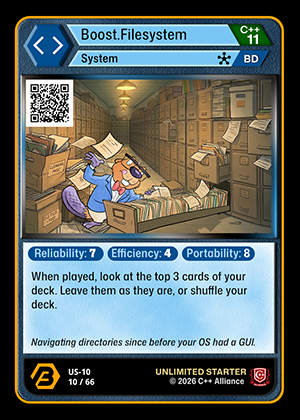
Boost is a collection of about 180 of them for the C++ language, written and given away by people all over the world. The 25 Library cards in this deck are 25 of those, with their real names, their real jobs and their real awkward habits.

A library is somebody else's finished work that you get to build on top of. Almost everything you use today, from the game on your phone to the site you're reading this on, is mostly other people's libraries with a thin layer of somebody's own idea on top.

Eight kinds of job

Look at the coloured banner across the top of a Library card and you'll find one of eight words. That's the group: what sort of problem this piece solves. Programmers really do sort their tools this way, because when you're stuck you don't want "a library", you want a library that does this kind of thing.

Networking

Talking to other computers. Everything that leaves your machine and comes back with an answer.

Boost.Beast · Boost.Asio · Boost.URL
web pages, chat, live scores

Data

Keeping information so you can find it again instantly, even when there's a colossal amount of it.

Boost.JSON · Boost.Unordered · Boost.Container
saves, scores, messages

System

Talking to the computer itself: its files, its folders, the other programs running on it.

Boost.Filesystem · Boost.Process · Boost.Log
opening and saving files

Math

Numbers, shapes and chance: working out where something is, or how likely it is.

Boost.Geometry · Boost.Math · Boost.Random
maps, physics, dice rolls

Parsing

Reading something a human typed and working out what it says.

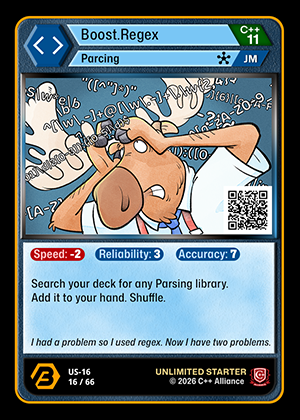
Boost.Regex · Boost.Spirit · Boost.Parser
search boxes, file formats

Meta

Code about code. Tools that write or inspect other parts of the program while it's being built.

Boost.MP11 · Boost.Describe
the robots in the workshop

Utility

Small, sharp tools you end up reaching for in nearly every project.

Boost.SmartPtr · Boost.CRC
tidying up, checking nothing broke

Diagnostics

Proving your program does what you claim. The part beginners skip and professionals never do.

Boost.Test
catching it before your users do

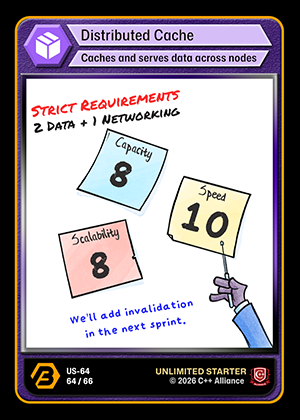
A Feature card asks for particular groups, "2 Networking and 1 Data", for the same reason a real job does: you cannot build a website out of three maths libraries, however good they are at maths. This kinds-of-library rule is a Strict-Mode rule. In Casual you can reach a Feature's numbers with any libraries you like, the way you would when you're first learning and just want to see something work.

What the numbers mean

Each Library card shows up to three numbers. They are not power levels. Each one is a thing people argue about when they choose what to build with, and every one of them is a promise the library is making about itself.

Speed

How quickly the work gets done. The difference between a page appearing and a page you wait for.

high: Boost.Unordered +10

Reliability

How often it just works. Low reliability means surprises, and surprises at 3am are how people lose weekends.

high: Boost.Filesystem +7

Scalability

Whether it still copes when a hundred times as many people turn up at once.

high: Boost.Asio +9

Efficiency

How little it wastes: memory, battery, heat. Why your phone is warm.

high: Boost.Unordered +9

Portability

Whether the same work runs on a Mac, a Windows PC, a phone and a washing machine.

high: Boost.Filesystem +8

Accuracy

Whether the answer is exactly right, every time. For money and medicine, "nearly" is a bug.

high: Boost.CRC +9

Capacity

How much it can hold at once before it runs out of room.

high: Boost.Bloom +9

Flexibility

How many different jobs you can bend it to without it complaining.

high: Boost.OpenMethod +10

Notice that some numbers on real cards are negative: they have a minus sign in front. A minus just means the library is a little bit worse at that one thing, so instead of adding to your total there, it takes some away. Think of a racing car: amazingly fast, but it breaks down far more often than the family car does.

Boost.Beast is the racing car. It is the quickest way to serve a web page, and its −1 reliability is the card's honest way of saying "I'm fast, but every so often I trip." Boost.Unordered is the same idea taken further: blazing speed, and −3 accuracy because it doesn't bother keeping things in tidy order.

Those minus numbers aren't the designers being unkind. Real libraries have weak spots, and a card that hid them would be lying to you.

Why a Feature needs three of them

A Feature is a job to finish: a web server, a dashboard, firmware for a device. It asks for two things at once: the right kinds of library, and enough of the right numbers between them. No single card can do it. Real software gets assembled out of parts, and so does a Feature.

Worked example · Feature: Web Server

It needs 2 Networking + 1 Data (that kinds part only in Strict Mode) and, in either mode, these numbers between them: Speed 12, Reliability 5, Scalability 10. Here's a hand that does both.

LibraryGroupSpeedReliabilityScalability
Boost.BeastNetworking9−17
Boost.AsioNetworking439
Boost.ContainerData030
Total13516
Feature needs12 ✓ 5 ✓10 ✓

Look at reliability: exactly 5, with nothing to spare. Beast, the fast one, actually takes a point away here (that's its −1), so the other two have to make up for it. The only reason this build reaches 5 at all is the +3 that quiet little Container brings along. Swap Container out for something flashier and the total slips under 5, and the web server doesn't ship.

The winning hand is rarely the one with the biggest numbers on it. It's the one where the weaknesses cover each other.

Dependency chains, and why they break things

Here's the idea this game teaches better than any diagram: libraries use other libraries. When you pick one up, you pick up everything underneath it too. That stack underneath is called a dependency chain, and the little icon on a card is telling you it has one.

Take Boost.Bloom, which answers "have I definitely seen this before?" for gigantic lists. In the real world it is built on top of two other cards in this very deck:

Boost.BloomData · what you wanted to play
built on ↓
Boost.Hash2Data · turns anything into a number
built on ↓
Boost.MP11Meta · the floor everything rests on

You wanted one card. In real life you have quietly taken on three, and really even more, because each of those rests on others again. A true picture of everything Bloom depends on would fill a wall. If the game made you own every last piece before you could play anything, no game would ever start, which is exactly the trap real projects fall into. So the cards draw only a slice of the tree, just enough to give you the feel of it and make you think ahead.

Because of that, the game is kinder than the diagram looks. In Strict Mode, playing a card like Bloom asks only that one of the pieces it names is already on the table, not the whole ladder underneath. Fall short and the card suffers a dependency crash: it flips face-down and stops helping you until you put the missing piece down, just as real software falls over when something beneath it isn't there. (In Casual Mode there are no crashes at all, so you can play anything, in any order.)

The cards worth grabbing early are the hubs (Boost.MP11, Boost.Hash2, Boost.Describe): the ones the most other cards point down to, so having one on the table tends to keep the cards above it happy. Notice a card like Boost.Unordered isn't a hub, so nothing is forced to have it. In the real world the hub libraries are looked after with enormous care, because a mistake in one of them is a mistake in everything built above it. It is unglamorous work, and doing it well is a whole career.

Nothing is good at everything

If you remember one thing from this page, make it this one. There is no best library, only the right library for what you're doing right now, and choosing it always costs you something else:

  • Boost.Unordered. Speed +10, efficiency +9, accuracy −3. Wonderfully fast at finding things. Ask it for perfect ordering and it shrugs.
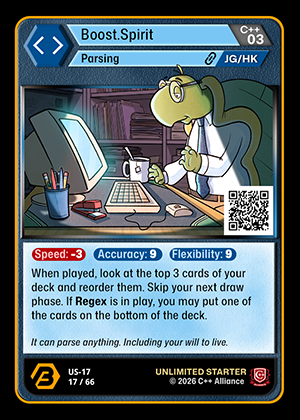
  • Boost.Spirit. Accuracy +9, flexibility +9, speed −3. It can read almost any format you invent. It is in no hurry about it.
  • Boost.Beast. Speed +9, reliability −1. The quick way to serve the web, with sharp edges you're expected to know about.

Every engineer you will ever meet is making this trade, all day. Fast or careful. Simple or flexible. Ship it now or make it last. The cards just say the quiet part out loud.

For parents and teachers

A player who gets to the end of a match has handled, without being taught them as topics: code reuse, dependency graphs and transitive dependencies, API contracts (a Feature's requirements), non-functional requirements (the eight stats), engineering trade-offs, versioning (the C++ version printed on each card is the minimum the library needs), and testing as a first-class activity rather than an afterthought. The libraries are genuine, the dependencies the cards draw are real ones (a deliberately thinned slice of a much larger tree, so the game stays playable), and the numbers are a fair caricature of each library's real reputation. Card-type requirements and dependency crashes apply in Strict Mode; Casual Mode checks only the three-library minimum and a Feature's stat targets, which is where most newcomers begin.

No account is needed to play in a browser, and the game collects nothing about who is playing. The privacy notice has the detail. It is aimed at roughly eight and up; younger players do fine with someone reading the Feature cards with them.

Play it in your browser →
/rules/

Official Rules

Developer's Edition, v3. Everything you need to play, in one place.

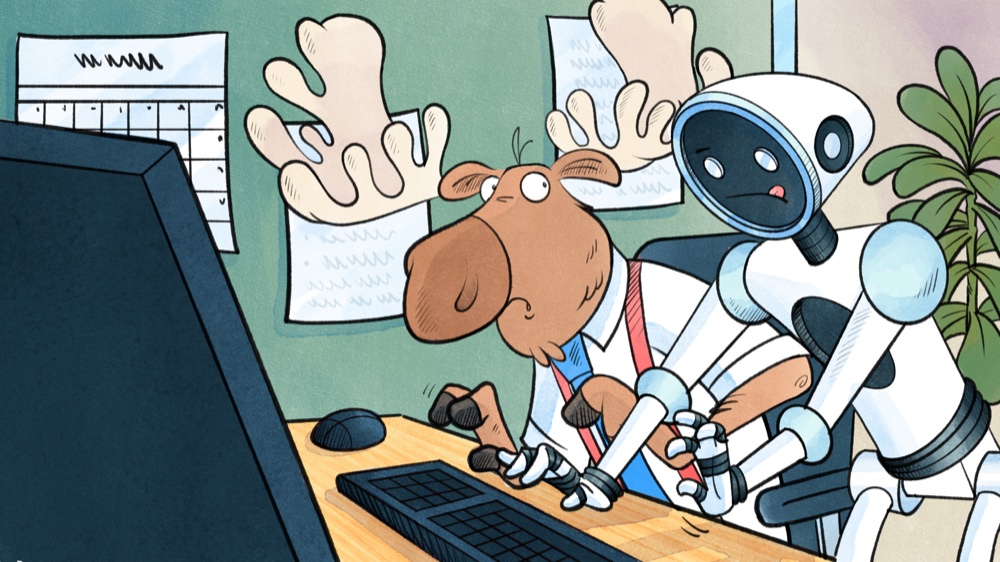
A detective alligator poring over the rulebook
"Where builds fail fast, dependencies are real, and segfaults are forever."
The complete rulebook ships printed inside every starter deck, and lives here, always current.

Every developer starts somewhere, usually with a half-compiled idea and a main deck.

Setup

Two or more players compete (or collaborate) to build Features faster and cleaner than their peers. Each player builds a deck of at least 40 cards from Libraries, Tools, Events, and Author cards. Your starter ships with 66 cards, more than you need. Paring it down is your first deckbuilding decision, before you ever open a booster.

All cards except Features live in your shuffled main deck. Feature cards are kept in a separate Side Deck: your backlog, the tasks your manager assigned while you were on vacation. It isn't part of your 40-card minimum.

Boost.Core and Boost.System are always in play. They have no physical cards, they are the #include <foundation> of your soul. They cannot be targeted, removed, or affected by any effect.

Before shuffling, agree how many Features must be built to win:

  • One: a quick match.
  • Two: standard.
  • Three: a full session.

Then, in a nod to real life, your opponent chooses which Features you'll be responsible for from your Side Deck. Each player draws five cards. Decide who goes first (coin flip, rock-paper-scissors, or rand() % 2); in rematches, the loser goes first. Finally, pick a Play Mode: Casual, Strict, or Cooperative.

Card Types
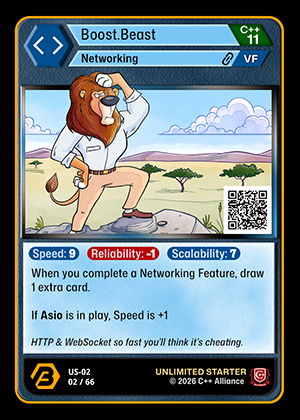
Boost.Beast, a sample Library card

Library

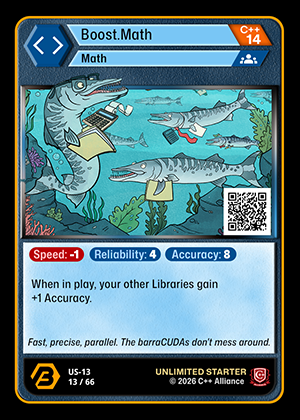
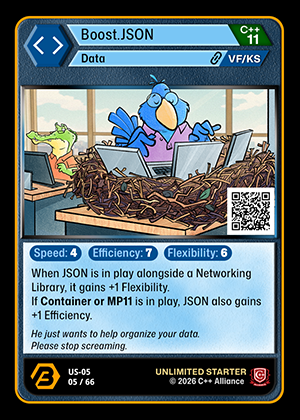
Your dependencies, the building blocks of every project. Each Library provides up to three stats (Speed, Reliability, Efficiency, Scalability, Portability, Accuracy, Capacity, Flexibility). Stats can be negative: fast libraries may be unreliable; powerful parsers may be slow. Every card is a tradeoff, just like real library selection. Libraries are always face-up; the only hidden information is your hand and deck.

Each Library shows its title, group (Networking, Data, System, Math, Parsing, Meta, Utility, Diagnostics), minimum C++ version, up to three stats, an ability, and flavor text. When a Feature is completed, contributing Libraries (except one you keep) are shuffled back into your deck.
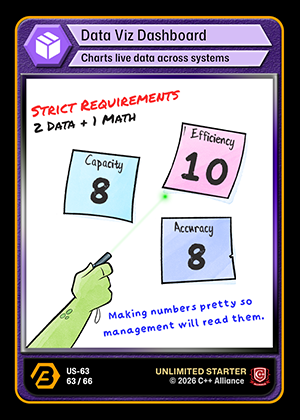
Data Viz Dashboard, a sample Feature card

Feature

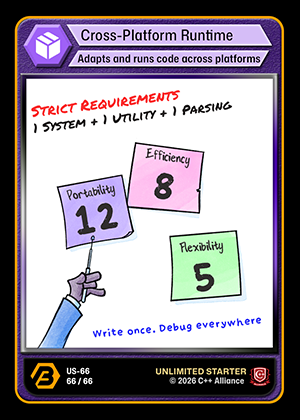
Your project goals, a whiteboard of post-it notes listing two layers of requirements: card-type requirements (minimum Library types, e.g. "1 System + 1 Utility + 1 Data") and stat thresholds (e.g. "Speed ≥ 12, Reliability ≥ 5"). Type requirements are a floor, not a ceiling: you need at least the listed types, but every Library on your field contributes its stats. Each Feature needs a minimum of 3 Library cards to complete. When requirements are met and QA passes, flip the Feature upside-down; it stays as a badge of honor and counts toward victory.
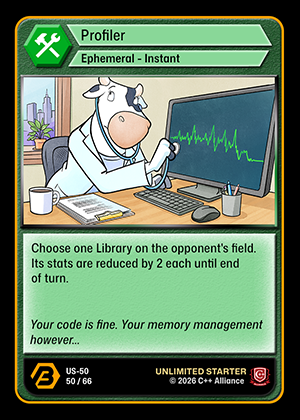
Profiler, a sample Tool card

Tool

Your editors, linters, and profilers, Ephemeral or Persistent depending on the text. Some are Instant (playable any time, even on your opponent's turn). Persistent Tool limit: 2. To play a third, first discard one. Ephemeral and Attached Tools don't count toward the limit.
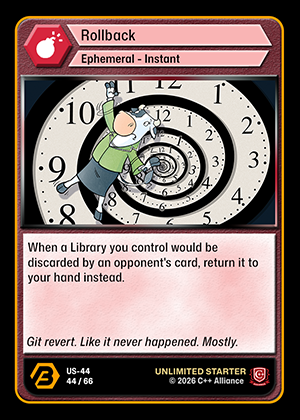
Rollback, a sample Event card

Event

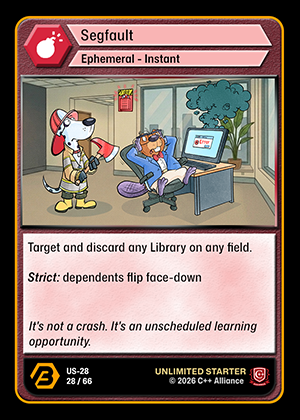
The chaos of software development: code reviews, bugs, merge conflicts, heroic refactors. Events can be Ephemeral (one-shot), Persistent (until removed), Broadcast (affects all players), or Instant.

Attached subtype

Some Tools and Events attach to a specific Library rather than taking a free-standing slot. While attached, the card sits with its host, doesn't count toward the Persistent Tool limit, and leaves the field when the host does.
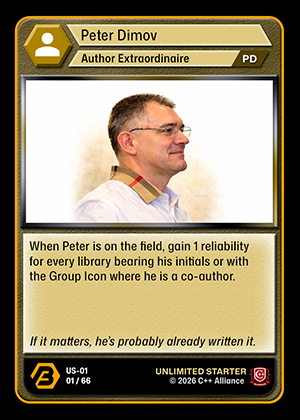
Peter Dimov, a sample Author card

Author

The developers behind the libraries. Each Library shows its author initials; Author cards interact with matching Libraries. Authors sit in a zone that doesn't count toward the 5-Library limit; maximum 3 Authors in play. Play an Author with your Library action, or co-play one for free alongside a Library they authored. Bonuses stack cumulatively. Some multi-author Libraries show a Group Icon instead of initials, scan the card's QR code for the full author list.

Card text overrides. When a card conflicts with these rules, the card wins. The rulebook is the README; the card is the source. Conflicting effects chain and resolve in reverse order; last commit wins until someone reverts.

Dependency Icons

Libraries show up to two icons in the type banner:

  • Hub: referenced by other Libraries. In Strict Mode, removing a Hub triggers Dependency Crash in everything that references it. Protect these, or target them.
  • Dependency: references another Library (shown in bold in its text). In Strict Mode it can't be played unless the referenced Library is already on a field.

A Library may show both. In Casual Mode these icons are informational only.

The bonus line is the dependency. Libraries don't carry a separate "requires X" line. If a card's text names another Library for a bonus (“if Mp11 is in play, gain…”), that named Library is also its dependency: one sentence doing both jobs. In Strict Mode the card can only be played once the named Library is in play; in Casual Mode the same text is just a bonus. A card may name one or two Libraries (multiple named = multiple dependency/bonus sources).

Domains & Categories

A Library's subtype bar can carry more than one tag, and they are two different systems:

  • Domain. The first tag, and the only one a Feature matches against (e.g. “2 Networking + 1 Data”). Every Library has exactly one domain. The eight domains are Networking, Data, System, Math, Parsing, Meta, Utility, and Diagnostics.
  • Category. Any tag after the domain. Categories are used only by card effects (“your Coroutine libraries gain…”); a Feature never requires a category.

The one rule to remember: Features match the first tag only. Everything after the domain is a category for card effects, never something a Feature can require. Format is Domain · Category.

How categories stay future-proof

A category is a shared noun that effects reference by the noun, never by a card's proper name, so a card printed today can be affected by an effect printed years later, with no errata, icons, or reprints. A card declares its own membership: if its name is the category (e.g. Build System) it qualifies automatically; if its name differs, its text says “… is a Build System.” That one sentence is the whole opt-in, readable on the card face with no rulebook lookup. Any icon is cosmetic shorthand only; the card text is authoritative.

The Field & Shared C++ Version

Field limit: 5 Libraries. To play a sixth, discard one first (in Strict Mode, discarding a depended-on Library triggers a crash). The C++ version is a global state affecting both players. By default the current standard is in effect and any Library may be played. A version-restriction effect locks both players; you can't lock only your opponent. So restriction cards are only worth it if your deck handles them better than theirs.

Full zones swap. To play a Library or Persistent into a zone that's already at its limit (5 Libraries / 2 Persistent Tools), first send one card from that zone to the discard pile, then play the new one. You can't otherwise remove your own fielded cards.

Turn Order

Each turn is a development sprint.

Draw phase

Pull one card. If your deck is empty when you must draw, you've burned out and lose immediately; there is no garbage collector for developer exhaustion.

Main phase

Your Main Phase runs as two steps, in order: Library first, then Tool or Event. Move forward through them; once you begin the Tool/Event step you can't go back to play a Library.

  • Library step. You may play one Library to your field. (Your field holds 5 Libraries; to play into a full field, send one Library there to the discard first.)
  • Tool/Event step. You may play one Tool or one Event.

You may skip either step. Instants are exempt: play them any time it's legal, on either player's turn, and they never count as your Library or your Tool/Event play.

Build check

If your field meets your current Feature's type gates and stat thresholds, you may submit for QA. You're never forced to. Ship it now, or make it right?

End phase

Clean up "until end of turn" effects, discard down to 7 cards, pass control.

QA Phase

Your code compiles, but can it survive inspection?

1 · Submit for QA

Confirm all required types are present, all stat thresholds are met, and you have at least 3 Libraries assigned. Announce: "Submitting for QA."

2 · QA Response Window

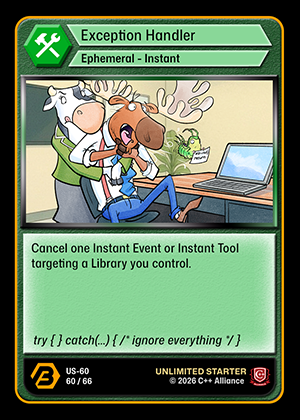
Before QA resolves, your opponent may play one Instant. Each Instant opens a new window for the other player; the chain continues until someone declines, then resolves in reverse order. This is the poker moment: do they have a Segfault? Do you have an Exception Handler?

3 · Reliability check

Add up the Reliability of all assigned Libraries, including bonuses. If a Feature lists no Reliability minimum, treat it as 0.

  • Reliability ≥ 12: QA passes automatically.
  • Below 12 but ≥ the Feature's minimum: attempt Manual QA.
  • Below the minimum: cannot submit. Write more tests.
QA difficulty = the auto-pass threshold (default 12) plus the Feature's Reliability minimum. Some cards modify it; unless stated otherwise, modifiers apply to the auto-pass threshold.
4 · Manual QA

When QA doesn't auto-pass, choose your test method:

MethodHow it worksBest for
Knowledge TestOpponent asks a factual programming/C++ question with a clear answer. 30 seconds. Correct = pass.Devs who want to flex
Skill ChallengeA safe, short, harmless physical challenge, balance a pencil, toss a card into a hat, keep a straight face.Casual fun, conference energy
Code ReviewDraw 3 cards. If 2+ are Libraries, QA passes. Return all 3 and shuffle.Fast play, no outside knowledge
Demo DayOpponent picks one contributing Library; explain what it does in your own words. They judge.Learning & teaching Boost

Agree on available methods at the start, or allow free choice. The rule of thumb: if everyone's laughing by the end of QA, you did it right. Knowledge questions must be objective; skill challenges must be safe and inclusive; players may decline any challenge (it counts as a failed QA).

5 · One check per turn

A QA check is a single attempt. When you submit, players alternate responding with Instants until both decline, and the Feature's total is then evaluated once. If it fails at that evaluation, you cannot initiate another QA check this turn unless a card explicitly grants an additional attempt. Recovering Libraries or stats after a failed check does not itself grant a new attempt. If you want a recovery card to save the current check, you have to play it inside the QA Response Window, before the check resolves.

Feature Completion

When a Feature's requirements are met and QA passes:

  1. Mark the Feature. Turn it upside-down. It stays on your field as a badge of honor and counts toward victory.
  2. Reveal your next Feature. See (or choose) the Feature you'll build next, so your keep decision is informed.
  3. Keep 1 Library. Choose one Library on your field to carry into the next Feature. (If it references a Library that's about to leave, it flips face-down until you replay that dependency, so keeping a hub is usually safer than keeping a dependent.)
  4. Clear the rest of your field.
    • All other Libraries shuffle back into your deck. A card attached to a leaving Library leaves with it and goes to the discard. A card attached to the Library you kept stays with it.
    • Your free-standing persistents go to the discard: your Persistent Tools, plus any Persistent or Broadcast Event you control that isn't attached. Resolve any "when removed" text as they leave. Your opponent's persistents are untouched; theirs clear when they complete a Feature of their own.
  5. Refill your hand to 5 cards. If you already have 5 or more, don't draw.
  6. Begin the next Feature.

Field progression: Feature 1 starts with 0 kept (5 open slots), Feature 2 with 1 kept, Feature 3 with 2 kept, then you win.

Dependency Crash (Strict Mode)

When a Library leaves the field, any Library referencing it flips face-down, cascading fully through the chain. Replaying the missing dependency reactivates and re-cascades the whole chain. Face-down Libraries stay on the field and use a slot, but contribute nothing and can be voluntarily discarded. In Casual Mode, dependency crash is ignored.

Instants & Timing

Instants play any time, your turn, the opponent's, or the QA window. Each Instant opens a response window for the other player; the chain resolves in reverse order, like a call stack unwinding after a panic. Instant limit: a custom deck may include a maximum of 8 Instants. The starter ships with exactly 8, so booster Instants are replacements, not additions.

Effect Duration: Continuous vs. One-Time

Whether an effect ends when its source card leaves play is told by the card's own wording:

  • Continuous. Worded “while in play,” “while this is out,” “as long as.” These are ongoing auras the source actively holds up. Remove the source and the effect ends immediately; anything it was holding reverts. Example: Legacy System's silencing ends the moment it's removed, and the silenced Libraries wake back up.
  • One-time. Worded as happening on an event: “when you play,” “enters,” “when this happens.” The effect fires once and the resulting state now belongs to the affected card, not the source. The source leaving does not reverse it.

Player tell: “while / as long as” = ongoing = reverts on removal. “when / enters” = already done = stays.

Play Modes

Casual: any Library any time; dependencies are optional bonuses; no crash.
Strict: dependencies enforced, crash active, full cascade; for players who read compiler warnings.
Cooperative: build together against the backlog (see below).
Cooperative Mode

Developers unite, no opponent, no lose condition, just shipping software that works. Each player has their own deck and 5-slot field; pick 2 Features from the combined Side Deck to build simultaneously. Libraries from both fields contribute to either Feature (committed at QA). Events fire on draw. There's no QA Response Window; combined Reliability from both fields counts toward the ≥ 12 auto-pass. Co-op decks must be at least 1/3 unique Events (min 14 in a 40-card deck), the chaos is the game. Scale up: Easy = 2 Features, Medium = 3 random, Hard = 4+ random.

Deckbuilding

  • Minimum 40 cards in the main deck.
  • Maximum 8 Instants.
  • Maximum 2 Persistent Tools on the field at once.
  • Cooperative: at least 1/3 unique Events (min 14 in 40).
  • The Feature Side Deck is separate (not part of your 40) and must hold at least 4 Features, or double the number required to win if that is greater, with no duplicates.

Multiplayer & Challenge Variants

For three or four developers:

  • Competitive Teams: first team to deliver all Features wins.
  • Co-op Free-for-All: one shared backlog.
  • King of the Mountain: build alone; first to finish gets promoted.

Challenge modes:

  • Speed Build: first to one Feature; the conference-table special.
  • Endurance Build: survive five-plus Features of feature creep.
  • Random Assignment: Features dealt blindly, because management never reads your skill set.

Victory

Competitive: you win when all your assigned Features are complete, no shared commits, no ties. If your deck runs dry and you can't draw, you burn out and lose. You may concede any time, just say "I've got a better offer" and hand in your cards.

Cooperative: complete as many Features together as possible; there's no lose condition, just the satisfaction of shipping.

Stat Guidelines

Eight possible stats: Speed, Reliability, Scalability, Efficiency, Portability, Accuracy, Capacity, Flexibility. Each card shows up to 3, positive or negative; unlisted stats are 0. A card's own ability may add stats not listed on it; external modifiers only affect stats already listed. Negative stats keep each Library distinct and force real deckbuilding choices.

Glossary

Field
Where active Libraries and Persistent cards live. Max 5 Libraries.
Deck
Your draw pile. Empty = you burn out.
Feature Side Deck
The backlog your manager assigned you.
Instant
Play anytime, usually at the worst moment. Max 8 per deck.
Ephemeral
One-shot. Used and discarded.
Persistent
Stays until removed by an effect that removes Persistent effects.
Attached
A subtype that attaches to a Library; doesn't count toward the 2-Persistent-Tool limit; leaves with its host.
Broadcast
Affects all players equally. Misery loves company.
Domain
The first tag on a Library's subtype bar and the only one Features match. One per Library: Networking, Data, System, Math, Parsing, Meta, Utility, or Diagnostics.
Category
A shared noun after the domain, used only by card effects (never matched by a Feature). Cards join by name; effects reference the category, not a specific card.
Dependency
A Library referenced in another's ability text. Required in Strict Mode.
Dependency Crash
Removing a dependency flips all referencing Libraries face-down. Cascades fully.
Silenced
A silenced Library's abilities are off and it can't contribute to Features. It stays on the field but fully inert until the silencing effect is removed (e.g. Legacy System's version lock). Can still be discarded.
Hub Card
A Library others depend on. Marked ✳. Protect, or target.
QA Auto-Pass
Reliability ≥ 12. Completes without Manual QA.
QA Response Window
The moment after "Submitting for QA" when opponents may play Instants.
Author Zone
Where Authors sit. Doesn't count toward the 5-Library limit. Max 3.
Implicit
Core and System. Always in play. No cards. Untouchable. Eternal.

Victory takes more than finishing the build. You have to survive the process, debug your deck, manage your dependencies, and ship anyway.

// card database

Card List

Every card, sorted by set and type. We don't publish the stats, go find out, or argue about it with everyone else. Deck-building limits beyond the per-card max live in the Rules.

The Max / deck column is a per-card limit: how many copies of that one card a deck may hold. The marked types also have a deck-wide ceiling on top of it:
* A deck may hold 8 Instants in total, counting every Instant card together.
† A deck may hold 6 Persistents in total, counting every Persistent card together.
Card types are colour-coded to match the printed frames: Library, Feature, Tool, Event, Author. Rarities: Common · Uncommon · Rare · Legendary. Booster contents are added as sets are finalised.

/order/

Get Boost CCG

The starter deck and the 2026 booster set are available to order now and ship worldwide: a complete, ready-to-play game built entirely from the real Boost libraries, plus a booster to expand it. New here? You can play a full game free in your browser before you buy.

Boost CCG Unlimited Starter Deck box and cards

Starter Deck

$24.99

66 cards, a complete, ready-to-play deck for one player. Includes the quick start instructions and links to the full rules.

Buy a starter
Link the moose and the AI booster cards

2026 Booster Set

$13.99

First unlimited booster set, based on the CppCon booster. Linen-finish stock; expand your deck and chase the foils, every Rare is foil.

Buy a booster

Try It Free

Free

Not ready to buy? Play a full game against the Compiler right in your browser, no account, no download. It teaches the physical game as you go.

Play in your browser →

// Starter decks and boosters ship worldwide via The Game Crafter. The CppCon limited print run was a conference-only edition; the 2026 unlimited booster has the same cards and is available to everyone.

/about/

About the Game

Boost CCG is a celebration of the Boost C++ libraries and the community that built them, turned into something you can hold, shuffle and play.

Why a card game

Boost, made tangible

Boost has shaped C++ for over two decades. This game gives the ecosystem a face: every Library, Tool and Author becomes a card with stats, art and flavor, a way for the community to share its identity at conferences, on tables, and with the next generation discovering Boost.

The world

Stats, types & animals

Cards live or die by eight stats, Speed, Reliability, Scalability, Efficiency, Portability, Accuracy, Capacity, Flexibility, across five card types. A cast of mascots gives the set its look and humor.

The cast

Mascots

Patch the beaver
Patch
Beaver · Junior dev
The protagonist. Relentlessly optimistic: believes every bug is fixable and every feature shippable if you just keep building. Eager, earnest, and occasionally in over his head.
Stack the capybara
Stack
Capybara · Senior dev
Unflappable. Nothing (not a prod outage, not a rewrite, not a Friday deploy) gets a rise out of him. Calm, dry, and quietly competent.
Proc the crocodile
Proc
Crocodile · Senior dev
Pragmatic and blunt. Cuts the scope, kills the bikeshedding, ships it. Low patience for ceremony, high respect for working code.
Link the moose
Link
Moose · Manager
The sociable connector. Knows everyone, schedules everything, and smooths the friction between people. A people-person who'd rather talk it out than read the spec.
Trace the cow
Trace
Cow · Product manager
The one who actually knows where everything stands. Tracks tickets, timelines, and loose ends; keeps the team honest about what's really done versus "done."
The makers

Who builds it

Rob Beeston
Rob Beeston
creator · designer & production lead

Designs the cards, the rules, and the print run.

Bob Ostrom
Bob Ostrom
character artist

Brings the crew and the cards to life, and handles the art passes for print.

Stewardship & legal

Boost C++ CCG is produced under the C++ Alliance as a community project. All trademarks, product names, and company names are the property of their respective owners. Boost C++ CCG is not affiliated with, endorsed by, or sponsored by any named tools, libraries, or their creators; all references are made for educational and entertainment purposes only.

FAQ
Do I need to know C++ to play?
No. Casual Mode plays as a clean card game. Knowing Boost just makes the jokes land harder, and Strict Mode rewards understanding real dependencies and standards.
How big is a deck?
At least 40 cards in your main deck, plus a separate Feature Side Deck. Your 66-card starter is more than enough to begin, paring it down is your first deckbuilding decision.
How do you win?
Complete all the Features you've been assigned. One Feature for a quick match, two for standard, three for a full session.
Can we play with more than two people?
Yes, Competitive Teams, Co-op Free-for-All, and King of the Mountain all support three or four players.
Where is [my favorite library / author]?
Probably in a future set. There are hundreds of Boost libraries and a finite number of cards, so not everything made the first cut. If your favorite isn't here yet, take heart: neither is almost everything else. Keep an eye on upcoming boosters.
Boost libraries have way more dependencies than the cards show.
They sure do. A single library's real dependency graph could fill the whole table and end the friendship. We picked the dependencies that make for interesting decisions and quietly ignored the rest, because "accurate" and "fun" occasionally want different things, and at a game night, fun wins.
I have a suggestion for the game. Who do I tell?
Us, through the feedback form. All suggestions are welcome, and we read them. But "welcome" and "implemented" are different words with different meanings, so no promises. Some ideas ship, some go in the drawer, some were already in the drawer. Send it anyway.
Why aren't the std:: libraries included?
Because this is the Boost card game. The standard library is welcome to make its own. (We'd play it.) Many Boost libraries did shape what eventually landed in std::, so in a sense they're already represented, they just got there first and didn't take the credit.
This effect doesn't make sense with this library. / I don't agree with these stats.
You might be right. Game design involves a hundred small judgment calls, and reasonable people, especially C++ people, will disagree with some of them. Stats and effects are tuned for balance and for the joke as often as for realism, so if a card feels off, it may be off, or it may be doing something you'll appreciate three turns later. Either way, see the suggestions answer above.
The stats are wrong. [Library X] is faster/more reliable than the card says.
Almost certainly, in some benchmark, on some hardware, under some workload. Card stats are relative, balanced against each other so the game plays well, not absolute measurements you should cite in a code review. If you benchmark your deck, please do not send us the flamegraph.
Is this an official Boost project?
Yes. It's made by the C++ Alliance, the same folks who put real work into the Boost libraries themselves. The animals drawn on the cards are, admittedly, an editorial addition.
Why is [rival build system / language] portrayed unfavorably?
Artistic license, and a little bit of house style. No build systems were harmed in the making of this game, though a few had it coming.
Can I play with just the starter deck?
Absolutely. The starter is a complete game on its own, two people, one box, no boosters required. Boosters add libraries, hazards, and focus for people who want to build tighter decks, but you never need them to play.
Are the QR codes going to give me a rickroll?
They link to the official documentation for each library. Whether the docs feel like a rickroll is between you and the library.
I got a preview pack at CppCon 2025. Can I use it?
Yes! The look of the cards has changed a bit since then, for the better, thanks to the feedback we received. But your preview cards are still perfectly playable, and still special. Lucky you.
Feedback